Thursday, 1 August 2013

Why do so many projects fail?


The BBC’s Digital Media Initiative running £100m over budget. The UK Department for Transport having to reverse the sale of the West Coast rail franchise. G4S not providing enough trained security guards for the Olympics. Why did these high-profile projects fail?

Prof Eddie Obeng with a real-life qubot, a
QUBE avatar. Eddie is the one on the left.
“Despite having all the resources behind them, projects can still go wrong if you have the wrong mindset,” says Prof Eddie Obeng of Pentacle the Virtual Business School, winner of the Association for Project Management’s lifetime achievement award. “One reason is that if things go wrong, you look like a hero for fixing them. Conversely, if you deal with a problem before it happens, you get no credit. So often there’s little incentive to make sure in advance that everything goes smoothly.

“Another reason is that there are different types of project. Some times you know right from the start how the whole thing is going to unfold, but modern projects are often very unclear and a lot can change over the course of implementation. If the project manager doesn't know the right tricks, leadership and tools to use, then the whole venture can very easily go off the rails.”

To combat this, Prof Obeng and the APM are joining forces to host Conference: Zero, a one-day event promoting a zero tolerance approach to failure. Speakers will include people who have delivered perfect projects in global sporting events, digital broadcasting, banking and academia.
A crowd gathered on QUBE

Zero is being held entirely on QUBE, Pentacle’s virtual learning environment, so anyone anywhere in the world can join without having to worry about travel or accommodation. The conference is on Thursday 17th October, and runs from 07.00 to 19.00 (UK time - click here to see when this will be in your time zone), so participants can choose when to attend. Anyone interested can find out more and register at http://PentacleTheVBS.com/Zero.htm

Friday, 26 July 2013

Who Killed the Sparq? – A Thrilling Read

In our last blogpost, we asked people who downloaded Prof Eddie Obeng’s new book Who Killed the Sparq? to send us pictures of them enjoying the book on holiday.

The best we’ve received so far is this one from Martin Baker of One Team Advisory:


Martin’s set the bar very high, so you’ll have to come up with something good to beat him!

You can download your copy of Who Killed the Sparq from http://PentacleTheVBS.com/WKS_FreeDownload.htm . You can link to your pictures in the comments, or email them to Admin@PentacleTheVBS.com

Wednesday, 17 July 2013

Something for your holiday break ... with a twist ...

Something for your holiday break?

As you prepare to pack up for your holidays (assuming you are in the northern hemisphere), I’d like to slip a book into your suitcase. Written in the same leisurely style as my other books - such as All Change! and Money Making Machine - and just like them, packing a punch, Who Killed the Sparq? is a ‘whodunnit’ about innovation. As usual, the fast-paced story, written from your point of view, masks the research and theories, making them digestible. You are compelled to read on in order to find out what happens next. Later in the book, again as usual, I point you towards useful tools, tips, techniques and behaviours such as ‘SmartFailure’.

I’ve taken the idea of an ebook one step further than normal. Not only do you get the convenience of your Kindle or iPad, but you also get lots of links to other World After Midnight resources and tools available from the interweb!

And the best bit is that it’s a free summer gift, with a twist you’ll discover on the download page.

You can download it from http://WhoKilledTheSparq.com

P.S. You may know that I also collect pictures of people reading my books in relaxing settings, for example next to the pool, in a bar, in a sun lounger, in a hammock … so if you do take a picture I’d appreciate you emailing it through!

Have an innovative and energising break.


Wednesday, 19 June 2013

Eddie Obeng is Actuary Pretty Good!

Prof Eddie Obeng spent some time with a group of actuaries this month, trying to reduce risk in a fast-changing world.

You too can learn more about our turbulent modern world, and how you can survive and thrive in it, at WorldAfterMidnight.com

Sunday, 16 June 2013

Beam Me Up!

Dr David Lomas is finalising the release of QUBE 2.5, which will include the 'Come Here' command, allowing you to "beam up" your colleagues to join you on QUBE. Last month we added a function which allowed you to invite and issue entry passes for colleagues via email. We are hoping that by giving you the power of remote teleportation, learning and working collaboratively will become seamless.

We will be very interested in your stories and experiences - you can comment here or email Admin@PentacleTheVBS.com

Tuesday, 21 May 2013

Forget the Slow Boat: Chinese Students Take the qUICk Route to the Future with QUBE

A riddle for you: Prof Eddie Obeng ran a session on “Leadership and organisation in a complex world” for 33 students at the United International College (UIC) in China … while working at a desk in the UK. How?

10 points if you said “QUBE”.

A joint venture between Beijing Normal University and Hong Kong Baptist University, UIC’s vision is to create a new innovative international education model in China. In the spirit of this vision, Dr Vincent Leung asked Pentacle to show his Human Resource Development students how they could learn without boundaries using virtual environments.

Each of the students logged on at a computer and transformed into a colourful “qubot” on QUBE. They were met by Eddie and Toby Scott, who introduced them to the New World way of working. The students were able to move around the qubicle as if it was a real room, put sticky notes up with their thoughts, and chat to each other and the Pentacle tutors. Some of them even discovered how to jump on to the roof – but they did need our help to get back down again!

The two-hour demonstration included Orientation, a brief tour of QUBE’s features, explanations on the World After Midnight and smart failure, and a Q&A session. With this vision of the effectiveness of virtual working and learning, the future now looks even brighter for these undergraduates, although that may just be due to the vivid colours on QUBE.

If you would like Pentacle to run a demonstration of QUBE for you, please get in touch at http://PentacleTheVBS.com/QUBE_TryIt.htm

Sunday, 31 March 2013

Virtual Isn't Working

So Yahoo and BestBuy are questioning working from home. Recently BlessingWhite have published an Employee Engagement Research Report Update for 2013, suggesting that ‘working remotely’ (with no one else present) makes you less engaged.

I can’t imagine Mozart being less motivated to compose in the absence of Salieri. The BlessingWhite survey and similar surveys are not about 'remote' working per se - that is, "people in different places or at home getting on with work". Instead they are really investigating what happens when employees (collaborators?) have to work in a different location to where the power centre (where the boss or most of their colleagues are located) is.

In our 21st century ‘world after midnight’, the concept of ‘working remotely’ is quaint. Nowadays many employees have a computer at home that is often better than that provided by the employer. I call people who still travel from a home (where they have great 21st-century computer) to an office (where they have to use a 20th-century, disabled, firewalled machine without Flash, YouTube, sound cards etc, etc) time travellers.

During the machine age, all the workers or employees had to huddle around the capital-intensive machine. So we would commute to and from home to a factory or an office (which was where the paper was stored or the computers were kept). So it made sense while we were huddled together for us to have social connections. In addition, the management could see and ‘oversee’ the work of the employees, and so the employees could rightly demand to know ‘how they were doing’ in order to reassure themselves that their jobs were safe, and also to give them a sense of pride. In the late 20th century, mostly as a result of trying to reduce office costs, employers encouraged the employees to work from home. This idea of working remotely (remotely from who?) was called ‘telecommuting’. Mary Ann Maserech of BlessingWhite describes 10 years of telecommuting to a headquarters building. But actually, the constraint of the expensive machine is now gone. The boundary of only being able to collaborate and oversee when in close proximity is now gone. The internet has seen to that. (In reality it is the data which does the ‘commuting’ not the employee.) So even through you may describe it as ‘working remotely’ you actually work locally.

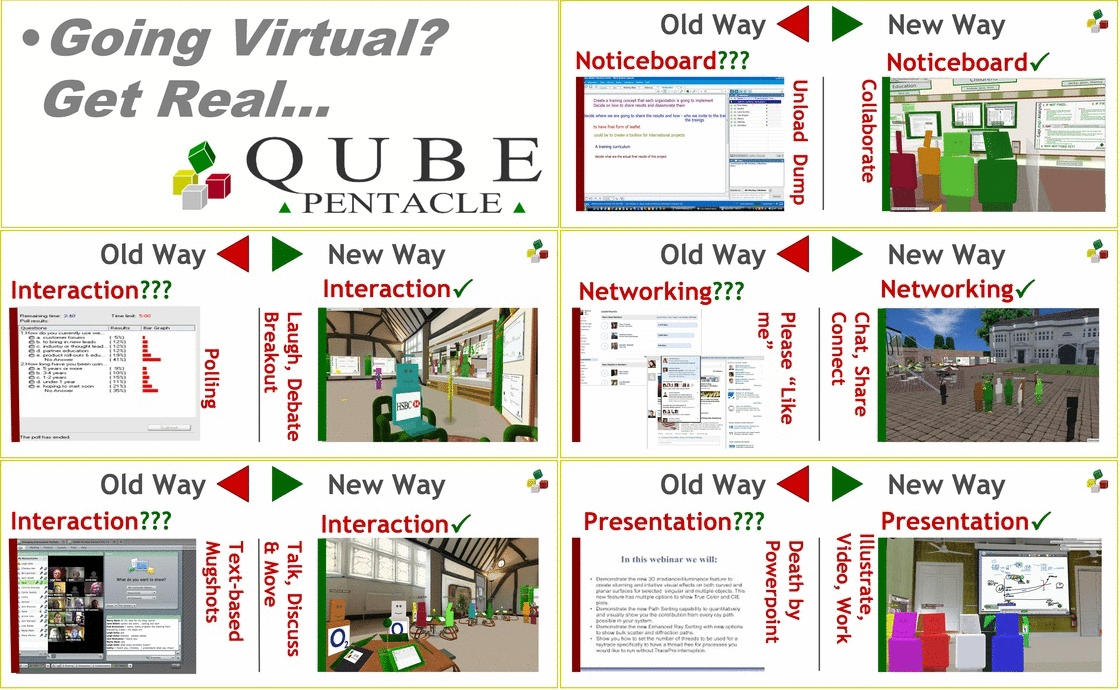
At Pentacle, as a networked organisation we expect people to contribute from where they are. The image shows Prof Eddie Obeng at work with three screens: the left one is for developing materials, writing articles etc and managing his day; the middle one for teaching, coaching and collaboration; and the right-hand one for external communications - email, LinkedIn, Twitter etc.  Pentacle has also managed to roll all the best of the 21st century into the learning and collaboration platform QUBE.  QUBE is basically Google Hangout, WebEx, Skype, Adobe Connect, GoToMeeting, Glance, Facebook and Dropbox all rolled into one... and surprisingly easy and intuitive to use. We use it for delivering our courses, conferences and coaching. It's also where we run our business. We huddle on QUBE, our personalities extended into special avatars called qubots, which allow head-to-head video conferencing.

Prof Obeng sitting at a
table, ready to engage
in head-to-head video conferencing.

We can sit confidentially, or stand together at a flip chart. Supplier meetings are held on QUBE, planning and agreeing course designs with clients happens on  QUBE.   Because the rooms (called qubicles) are real, they persist, and stay open 24 hours a day, so you can come back to them when you wish, or if you are working across time zones you can always leave a sticky note on a collaborator's desk!

We have open day events once a month. Join in and find out how about working without boundaries can make Virtual Work.


Friday, 15 March 2013

Don't Change Anything

Last month in Geneva, Prof Eddie Obeng presented a talk titled 'Don’t Change Anything'.  The title startled the audience, who thought they were going to session on making stuff happen.  Part of the inspiration for the talk was from the Pentacle LinkedIn Group, who had been asked about their experiences with change.  50% replied that less than 25% of the changes they made in their organisation led to an improvement!  Far more alarmingly, for 40% the changes they initiated Frequently (4 on a scale of 5 from Never to Always) led to unintended consequences!


So it’s not worth starting, and if you succeed you’ll regret it!  :-)  In other words Don’t Change
Anything
.  Unless you discover the secrets Eddie shared such as  'going' into the future' and looking back to see if your change will be an improvement and many others. 

Friday, 8 March 2013

Vinci Construct a Bridge from Ideas to Reality

2013 is set to be a challenging year for the global construction industry, so as one of it’s leading players Vinci, with a portfolio of projects from the Glass Pyramid of the Louvre to the Channel Tunnel and now to build a new high speed rail line in France, decided to use new ideas to supplement investment and have been focussing on developing the key leaders across the organisation and enabling them to work collaboratively and transversally.

At London Business School, a discovery programme led by Dr Jules Goddard (author of Uncommon Sense, Common Nonsense) is being run to support Vinci’s approach. As part of the programme, Prof Eddie Obeng of Pentacle introduced some key Performance Enhancement Tools (PETs) from the Pentacle library (including GapLeap and StickySteps) and worked with the participants as they explored how to transform their ideas into reality. With some concrete new thinking firmly cemented in their brains, the delegates left London with the materials they need to construct a great future.

Wednesday, 20 February 2013

Working Collaboratively, 24/7 – QUBE Explainer Video

Are you interested in transforming your organisation? We’ve created a way for you to share with your colleagues at work a common approach by creating a brand-new QUBE explainer video, created by a cutting-edge UK animator and the Pentacle team (who provided the voiceover, script and one of the really bad jokes).

In a few minutes, you’ll be able to explain to your colleagues how they can use New World thinking to directly improve their jobs and your organisation.


We are planning to make a second explainer video covering the actual learning experience and the technology, so tell us if this would be useful, and we’d love to hear your feedback on this video in the comments below. In particular, is it clear that QUBE offers an opportunity for business transformation through learning? Does it fire up your imagination to think what else QUBE could enable?

If you’d like to learn more about QUBE, get an entry pass for a cross-company event, or book a private demonstration for you and your colleagues, visit http://QUBE.cc

Friday, 15 February 2013

Eddie Takes on Business Dogma at the London School of Economics

On Saturday the 16th of February, Prof Eddie Obeng will be speaking at the London School of Economics as part of their “Where is Economics Heading? New Schools of Thought” conference.
Eddie’s talk will be titled “How an Interconnected World Rewrote the Orthodoxy of Business”. In it, he will challenge the standard academic thinking about economics by explaining the World After Midnight, and how actions that would have been sane and rational 15 years ago can now be pointless, and even damaging, in today’s financial climate.

If you’d like to learn more about the World After Midnight, visit http://WorldAfterMidnight.com. For learning that prepares you to thrive and survive in this turbulent environment, visit http://PentacleTheVBS.com

Tuesday, 12 February 2013

Linked to a Connected World

There are 7 billion people in the world. Apparently, 1 in 30 of those people are connected to each other on LinkedIn, the world’s largest professional network.

Now LinkedIn has contacted Pentacle to tell us that one of the key nodes in this network, one of the most popular people on the whole website, is none other than our very own director of learning, Prof Eddie Obeng. Eddie is in the top 1% of most viewed profiles in 2012 (although he missed out on having the most viewed profile to a Barack Something-or-Other in the US).

When asked to comment, Eddie said “Since I’m now a member of a club that would have me, we might as well throw a party in the New World Café on QUBE and invite the world.”

(If you don’t know how QUBE works, watch the short explainer video at http://QUBE.cc)

If you’d like to connect with Eddie on LinkedIn, you can find his profile here.

Monday, 4 February 2013

Classic, but not Old World – Eddie Obeng at Innovate ‘11

Everyone is looking for innovation, whether they are in the public, private or third sector. New ideas that will make everything faster, better and cheaper. The only problem is, innovating isn’t easy. Luckily though, organisations dedicated to imaginative solutions can meet like-minded businesspeople, government officials and academics at Innovate UK, an exhibition organised by the Technology Strategy Board and UK Trade & Investment.


To get people in the mood for Innovate UK 2013, @innovateuk tweeted a link to the opening keynote from Innovate ‘11, given by Prof Eddie Obeng.

Titled “Innovate or Die”, Eddie pointed out that while everyone says in public that they’re in favour of innovation, only one idea in 300,000 is actually successful and makes that company money. Part of the reason for this is that innovation has traditionally been thought of as a “funnel” – coming up with lots of ideas and then whittling them down to a single great idea. Instead, Eddie proposed using the RABBIT model – giving more support to a smaller number of ideas, so that they’re “healthy” enough to make it all the way. The audience were kept on their toes by the way Eddie kept asking them to discuss the concepts among themselves and challenge each other’s opinions.

If you’d like to see Eddie’s speech for yourself, you can watch it below.

Saturday, 26 January 2013

Leading to an African Future.. and Perhaps Yours

At Pentacle we are proud and excited about a project we have been in a small way involved in for some time.  And we think it will energise and inspire you also.

Professor Eddie Obeng, Dr Michael Anaman and Kwame Akuffo have for some time been supporting the African Leadership Insitiute's Archbishop Tutu Leadership programme.  Last year Al Jazeera filmed a cohort of leaders on their journey.  It really is a "must watch". You'll love the challenge, the emotion, and watching the participants grow into world-class leaders. Co-founders Peter Wilson & Sean Lance and the programme team have done a remarkable job of creating over many years, what must be one of the most powerful unique leadership programmes in the world.


Don't leave this for later, put aside everything and watch the first episode now.  Tweet about it. and let us know what you thought.

Wednesday, 9 January 2013

Happy New Year from Eddie Obeng


This article was written by Prof Eddie Obeng for his personal blog.

I'm sure you know the tired old proverb about 'Teaching a man to fish…'  It's a really brilliant but now obsolete piece of 'Old-World' thinking. It assumes that you already know about the existence of fish and that somebody (you) has the skill to catch them. I'm not so sure that is true today.  In our complex, fast-changing world there are few ‘Opportunities’ simply because everyone else recognises them, and by the time you try to get to them they’re probably already gone.  It makes little sense to keep looking for 'Opportunities' that you recognise. Instead the trick is to create and seek out 'Possibilities'… then transform them into ‘Your Opportunities’... and then craft them into‘Realities’. Today, you must IMAGINE A FISH!

Original Proverb: Give a man a fish and he feeds for a day.  Teach a man to fish and he feeds for a lifetime.

A decade ago I added my own two silent lines.  I invented them as mantra to inspire me to keep my quest for New World Leadership and Business Management moving through education & learning-by-sharing...

Teach a man how to learn how to fish and he may also learn how to hunt, farm, produce works of art or cook.

Teach a man how to teach others to fish and you feed the village and then the world. And for you, again for 2013 and onwards I now say - First, IMAGINE A FISH.

eddie obeng ____________________________________________