Friday, 31 January 2014

Dream or nightmare? You decide.

Image courtesy of
imagerymajestic/
FreeDigitalPhotos.net
It’s nearly midnight and you’re tired. It’s been a tough day at work - you and your team have been struggling recently. Everyone’s trying hard, but events keep moving on before you can work out how to respond. As you drift off to sleep, you remember the boss’s final words: “Bring everyone together for a 'Big Conference' to get back 'on top of things'.” What things? Certainly not the daily things that will still need doing while you’re all away somewhere else, or the budget that the same boss wants you to cut to hit team targets.

So, will you be having dreams or nightmares tonight?

Here is the nightmare. Some of the widely-spread team with a distance to travel don’t even want to meet, too busy struggling with their daily tasks to waste precious time talking rather than doing. Even those that do use the opportunity to avoid making decisions - everything will be decided anyway at the “Big Conference.” Resentment and inertia grip the team and everyone seems tense. You co-opt a reluctant team member to set up the event. He organises venue, flights and accommodation – it’s a big and costly task. The event seems to go OK: you capture some good ideas on the flipchart and leave with a vague sense of wellbeing.

A week later, your PA asks you to decipher the flipchart. You promise to when you get more time to remember. A month later, your boss asks you what the “Big Conference” achieved. Your reply doesn’t convince either of you. Six months later, she cuts your budget in half. A year later, you’re working harder than ever to cover and recruit to replace colleagues who recently left the organisation. Exit interviews show they liked their colleagues, but found it difficult to get anything done.

Here is the dream. The world is changing faster than you can learn. You can’t change the world, so you decide to change your approach. You ask one of your team to sketch out (roughly – a quick “guess-timate” will do) the likely cost a “Big Conference”, then tell your boss confidently you can save the company this money. You ask your team for ideas for working together more effectively, more creatively and feeling more engaged. Some are encouraged to brainstorm alternative ways to collaborate, while others are asked to suggest their own “drumbeat” sessions - how often they should meet to air new challenges and keep projects moving along quickly. The team come up with far more ideas than you ever expected, and suddenly you recall reading about something called QUBE


Whether you have nightmares or dreams in your World After Midnight is your choice. The dream is, in fact, a reality. Many leading companies are already using QUBE. It’s the ultimate medium for a world changing faster than it learns - a revolutionary, completely immersive, virtual environment for business. It’s a highly effective way for business people to run companies, innovate, collaborate and have fun. It’s like a company headquarters on the web, with new ways of sharing ideas plus great tools and techniques to help get things done. Over the coming weeks, we will be blogging on the experience of working and holding regular meetings and a conference on QUBE, with the help of our colleagues at the Association for Project Management.

The story unfolds …

Tuesday, 7 January 2014

When you can't make it into the office, don't end up going round in Merkels ...

A mock up of Angela Merkel on QUBE
An artist's impression of Angela Merkel
engaging in immersive virtual working.
As the first female chancellor of Germany, Angela Merkel doesn't usually have much time to put her feet up. And breaking her pelvis in a skiing accident hasn't slowed her down any. While her doctor has ordered her to rest for three weeks, she will still be chairing the first cabinet meeting of the new year, and will be in constant contact with her ministers by phone.

Of course, there's only so much you can share when you're just talking over the phone. You can't share a document with someone. Or stand shoulder to shoulder with a colleague and develop ideas on a whiteboard. Or switch between group discussions and private conversations in a matter of seconds.

Accidents happen, as does illness, or just having commitments that keep you at home. Being unable to move doesn't mean that you have to stop working. Prof Eddie Obeng posited the same thing here. Hopefully the word will get to Angela.

To learn and work better across time and distance, why not check out QUBE? Contact us to arrange a demonstration - http://PentacleTheVBS.com/QUBE_TryIt.htm

Friday, 13 December 2013

Money making machine discovered down mine!

This article was written by Prof Eddie Obeng and originally published on his personal blog.

Perhaps I should get one?  Perhaps you should get one?  David Lomas, Pentacle's techno wizard, alerted me to a once-in-a lifetime opportunity.

When I wrote Money Making Machine, I was looking for a way to align all the people in a business organisation to work together to collectively improve the performance of the organisation.  In a complex and fast-changing world, it is often really difficult to know whether the actions you are taking, the decisions you are making, and the conversations you're having are going to help your business make enough money to keep going.  The central idea is five Money Making Questions to align everyone.

But now there's almost no need.  Apparently, Avalon sell an ASIC machine that, for the small spending of $11,000, is capable of producing $50,000 in five months.  Over its useful working life of 31 months, it will make about $117,000!

If you've read Money Making Machine, you'll know that this is a fantastic answer to Question One.  Question Two - how fast you need to spend to run it - is all down to the amount of power it consumes: approximately 600 Watts.  We've already answered Question Three: it was $11,000.  As for Question Four, it depends on what you think of hashing and bitcoins.

But what about the most important question of all, Question Five?  Hmmm ... I think I'll pass on Avalon's offer and spend my time writing a blog instead.

You can discover your own Money Making Making for no money (no Question Three) here or buy one here to speed up mine.

Thursday, 28 November 2013

The Return of the Killer RABBIT's Inventor ...

Thinking Digital's Herb Kim and Professor Eddie Obeng together at the sequel to The Thinking Digital 2013 conference.  If you were there, you'll understand why sometimes Rabbits fight back! Eddie explained the RABBIT model of innovation, which he invented, having defined innovation as "a process for turning (new) ideas into money (benefits to society)".  The model elegantly explains how to focus and make this happen in your organisation.

You can read all about it in the free ebook download of Who Killed the Sparq? by Eddie Obeng.

Participants in the conference completed a healthcheck to pinpoint exactly what they needed to do to stimulate and deliver successful innovation.  

This latest conference was produced by Newcastle University Business School and Thinking Digital, and included keynote speakers Steve Vranakis, Illicco Ellia and Pam Warhurst.  

You can join the future conversation on WAM Innovation at hub-Q - go to http://PentacleTheVBS.com/InventTomorrow.htm

Sunday, 3 November 2013

Talking About Nothing

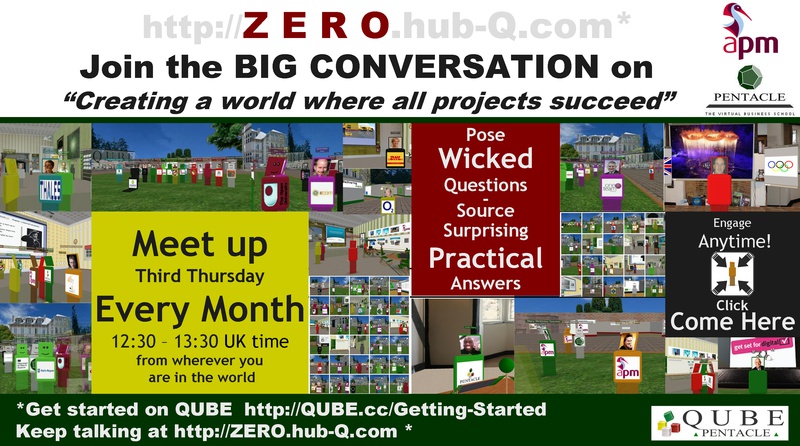
The doors are open and to kick off the Big Conversation about ZERO, "Creating a world where all projects succeed...".  We've invited all the participants of Conference: ZERO to add their questions, thoughts and comments to the ZERO_Community qubicle. If you're already on QUBE you can use this link ...

http://ZERO.hub-Q.com

The Big Conversation is open to all members of the APM, so join in and spread the aspiration.

Over the past two weeks the buzz has already begun - check out the comments and blogs (and tweets) on Conference: ZERO by Gower PublishingElizabeth HarrinAndrew Hubbard, Eddie Obeng and Dave Gordon.

Eddie Obeng will be on QUBE, along with anyone else who's available to join in, from 12.30 - 13.30 UK time on Thursday 21st November, to curate, facilitate and begin to co-ordinate the conversation.

If you can't make the time and date, please leave us your thoughts and comments in advance on the Main Whiteboard.

Eddie will share a framework for themes,  language and researching the issue of "why not all projects currently succeed".  He will invite people to lead aspects of the conversation and act as nodes for the delivery of the vision.

We need Sponsors for the ZERO_Community to keep the momentum.  Is this you?  Perhaps someone in your organisation?  Please help us.  You can find out more about sponsorship at http://PentacleTheVBS.com/SponsorshipWithoutBoundaries.htm  and read what other sponsors say.

If you missed Conference: ZERO, there is a summary below, and you can find out more about the speakers and topics at http://PentacleTheVBS.com/ZERO.htm


Tuesday, 22 October 2013

Review of Conference: ZERO


193 attendees from China to Bahrain to Brazil.  30 speakers from Australia to France to the USA.  Saving over 65,000 miles of travel (three times round the world) and earning a **** rating

Last Thursday we were proud to host Conference: ZERO on behalf of the Association for Project Management on QUBE.  The aim of the TED-style conference was to start the BIG conversation on “Creating a world where all projects succeed.”

Here’s an overview of what happened on the day: 

There were many amazing keynote sessions, including ones from Bill Morris LVO on The Olympic Ceremonies, Peter White on Delivering the Digital Switchover Perfect Project, John Mathers on Design and Projects, Andrew Bragg on APM’s Ambitious Vision for the Profession, and Martin Baker on Life or Death Projects

Many participants experienced delays in getting on QUBE due to two of our cloud routers turning rogue, and some suffered annoying crashes. If this is you and you were frustrated (not a perfectly successful project for you ;-) ) please contact me, Eddie_Obeng@PentacleTheVBS.com .  I’d like to say sorry, ask you to forgive us - since we are just starting on this journey - and propose a treat!

We also had interactive and engaging sessions from practitioners from HeadcastLab, JP Morgan, O2, DHL, Ernst & Young, Capgemini, Novo Nordisk, Amari, MWH Global, bloggers, journalists and many more.

There were practical workshops run by the Pentacle team on tools and techniques for everything from overcoming resistance to change to predicting the future issues and ‘preliminating’ them.

Lots and lots of connections were made, tweets sent out on #ConfZERO, and discussions started. Visit the photo gallery at http://Pentacle.co.uk/ZEROpics.htm .  If you took pictures or video on the day, or have blogged or tweeted, please let me know and I'll add them to the website.

What next? 


Let’s keep the discussion going.  Let’s share ideas and learning. Let’s try to speak the same language to make it easier, using the themes of the conference: purpose, perspective, practitioner, people and performance.  You’re on QUBE now, it’s like being on Skype.  You can see who’s live and summon them with a “Come here”  to meet you (see icon to the right). And if you’re on your smart phone, you can always find out using http://QUBE.cc/Whos-on-Now/ 

I look forward to seeing you again, as a qubot, soon.


eddie

Professor Eddie Obeng 

Friday, 13 September 2013

Effort to Benefit


It’s been a while since you’ve seen each other but it’s great to have some time and a few drinks with one of the few people who have known you since before you had the keys to the front door of your parent’s house.  It’s also been a while since they made their transition to the C suite and finally to the top job.  So this isn’t just a catch up and gossip, “Do you know what happened to ..?”  “Guess who I met in a market in Morocco…” and so on but a chance to talk about life and work.
You get to go first.  You ramble on about the pressures of delivery and the lack of resource.  Moan about a couple of your team members and a particularly troublesome but essential contractor.  Now it’s your turn to listen. 
Your friend begins “They just don’t get it.  I’ll tell you two stories and you tell me if it’s me that’s mad
or them.”  You nod supportively

As you know I’ve just taken over a new division and it’s unbelievable what I’ve found.  The first thing I unearthed was a huge project.  They’d called it TeleHealthy.  Over the previous 3 years they’d spent a small fortune on a concept.  The concept was that with more mobile devices coming online a multi billion pound business could be created.  The design was an ‘all or nothing’ affair, the entire platform had to be developed before we could sell subscriptions.  This is not uncommon for this type of application.  The project has been hailed as a success, it delivered on time to budget and with the specifications intact.  But so far, after spending millions we have seven subscribers paying us £75 per year.  How did we get the business case so badly wrong? How did we not notice that we were developing from a hunch not an insight?  And another one in this one we were trying to be modern and trendy.  Admittedly the brief was a bit unclear but in that market because of the pace of change, it was always going to be.  The previous CIO had decided to adopt an agile approach without much understanding.  He was absolutely delighted with progress – gone was the old way of doing things where there was no outcome, nothing to see until you discovered that there really was ‘nothing to see’ now he had updates deliverables.  But in their haste they managed to create a package which was un-testable.  But they rolled it out anyway – saying that the early adopter customers would help them to identify the bugs and that they had created a large team for rapid bug fixing and applying patches. 
Three months later not only had the customers not had any real benefits from the offer.  The problems, complaints negative tweets and so on had so damaged to the reputation of the business that sales in all other products had declined by 10%

You shake your head in empathy.  Yes, there really is something not-quite-right.  It’s something to do with remembering why we initiated the change in the first place.  Something about looking beyond the effort of the project, looking all the way from the reason why the project was begun all the way through the project’s lifecycle, to the benefits which would be delivered.  That is the complete project.

In a world where every project succeeds we need to redefine projects to not only include the effort but also to include the benefits we are after.  We need to extend our projects even earlier to the wisdom in the spark of the ideas which give rise to the initiative behind them and widen them to consider the wider collateral damage they can cause

Thursday, 12 September 2013

Isolated to Integrated


They’ve been using the slogans for years. 'There are no IT projects just projects',  'There are no HR projects just projects', 'There are no Ops projects just projects', and yet.  And yet you’ve spent the last two weeks trying to get sign off and the stakeholders are doing everything they can think of to keep their thumbprints off the documents.  Why?  And on that last project it was almost impossible to get into the diaries of the key stakeholders, the one’s who’d asked for the project in the first place, the one’s who’d have to live with what you were doing… and yet all you wanted to do was to spend time with them talking about the implications of the project and looking back at some of the key decision you’d made to check that they were the right ones.   It’s strange for all the talk projects often end up as isolated islands in a sea of BAU (business as usual)  You pause you don’t get it.  Perhaps that’s how it will always be.  You know that in general people are afraid to be openly seen to be working hard on, or backing something that might fail. Perhaps that’s why it’s so difficult to get the rest of the organisation to take a real, active interest in the project.  Maybe they’re just too busy with today’s priorities to dedicate time to tomorrow’s.

But what it means in practice is that however hard you try you end up throwing stuff ‘over the wall’.  And then they throw it back!   It’s not sponsorship you’re after just more connectedness to the rest of the organisation, perhaps someone who speaks the local language of the function and has a deep understanding of how the project will alter the way things are.  Perhaps someone who can also help to look backwards at progress so far to understand what is being delivered….?

Somehow you have to find a way to ensure that participating in projects, even for people not part of the project team, is as much part of the day job as the day job!  Convincing them that BAU is now CAU – change as usual.


In a world where every project succeeds, our organisations need to be persuaded to work with the people leading the change.  Program managers and sponsors are key in providing this bridge.

Soft is harder than Hard

You’ve been listening to the radio.  It seemed like a done deal.  You’ve followed the story for a month both parties had been squaring up to each other they had agreed the transfer fees, the players seemed happy, the agents had made statements to the press, the fans had even endorsed the deal and now the big news was that the deal was off!  All that agreement, and going along and now it seemed over-night, a change of minds, a change of hearts. 

clipartfox.com
The story on the radio feels familiar but in a different context.  You pause thinking bitterly about last week, all that agreement, and going along and now it seemed over-night, a change of minds, a change of hearts.  That was the problem with human beings you spoke to them one day they were on the same page.  You came back the following morning and you had no idea where they would be in their thinking.   And yet your PMBOK treated them as resources, human resources.  But they aren’t just resources, they are agents, actors, blockers collaborators.  They have as much power to drive the project on or off track as you do. It’s almost as if the logic of planning, risk removals and deliverables are easy compared to the complex intricacies of people, politics and power.

You knew how to plan and ‘read’ the project tasks, but what if you couldn’t read the people or plan ahead for the things they would do to push you off track?  I mean last week the struggle wasn’t between you , the sponsor and the head of HR, no it was just between the two of them.  Any damage to your project was just collateral damage.

There must be a way to more realistically include the impact of the aspect of the project which took up most of your emotional strength and time.


In a world where every project succeeds we need to develop the more insightful and people-based, softer aspects of project management. These, in practice, actually have a much bigger impact on overall success.

A-320 to glider


You’ve just finished watching that brilliant TED Talk.  No, not the one with the man in the orange
shirt, the one where the chap talks about “3 things I learned while my plane crashed  It’s powerful and moving.  You recall hearing the pilot interviewed about it and marveling about how he realised that at his rate of descent he wouldn’t reach the alternative airport the control tower proposed.  Every aircraft has its own glide-path and perhaps in a fibre-glass glider he might have made the distance but not in an Airbus A-320.  So he steered his aircraft which was now no longer one of the fastest and powerful transport planes but merely an aluminium glider into the Hudson River

But what would happen if a project had no pilot (project or change leader absent or completely ineffectual) and no power (ideas, and resources supplied at the right time)?  Would it land safely?  What would happen on the way down?

You’d love to sit back and put your feet on the desk and have a good, long, deep think, but this is the world of always-on mobile devices and global competition and being seen to be ‘relaxing’ or ‘thinking’ could mean you’re re-applying for your own job in a weeks time.  So you hunch over your desk in a ‘work’ posture hiding the fact that you’re trying to open your mind and think… and then the phone goes.  The news is not good.  One of your key project managers has had to quit for personal reasons.  Their absence is effective immediately.  You swear inwardly and then slowly it dawns on you. Slowly you realise that you now have pilot less project.

You allow yourself to look into the future to see what’s going to go right or wrong next. 

You quickly realise that what will happen next depends on the type of project.  If the goals and approach and methods are fixed clear and obvious to all the team members and stakeholders then the project will only stutter when a new decision point comes along or if any of the people stops delivering their accountabilities to the plan.  However if the goals were uncertain or evolving, or if the method and approach were also in flux or evolving the future path would be very different.  The more open the project is the wider the range of possible influences on its future.

You shift uncomfortably in your chair, you'd be more relaxed if you felt that the stakeholders and team had the fixed clarity and were effectively painting-by-numbers, but even so how would they know that someone hadn’t delivered to plan?  In some projects progress is obvious and measurable, like when you’re getting a new kitchen fitted at home, these ‘visible’ projects are much easier to track than say a culture change project.  But having said that visibility usually attracts interference,  In the same way as you hassle your builder at home the stakeholders try to meddle a bit too much.  So the level of visibility will also influence the future of the pilot-less project

As your mind hums you think ‘politics’ Some projects have a lot of organisational politics and in the absence of the guiding hand of the pilot the project will get ‘taken-over’ by partisan interests.  You know that projects, where the people driving the change are in the same organisation as those delivering the change, and where no real money is changing hands, are the ones which are most complex politically especially if the project is intended to change the power balance in the organisation (as significant projects often do). Your damp palms rub your temple as your head sinks into your hands.  Wait, in this project, the people driving the organisation are in another organisation to yours!  You have to deliver and there is a contract in place and real money will change hands.  Phew!  You won’t get embroiled in politics.  And then it dawns on you … but you will get involved in lots of contractual arguments and negotiations on quality, timing costs, service levels and…  You conclude, the Driver versus Deliverer balance that  the relationships, relevant positions and power of is who is driving the change and who has to deliver it will be very influential on the future of the project

In a world where every project succeeds we need to redefine projects to not only include the effort but also to include the benefits we are after.  We need to extend our projects even earlier to the wisdom in the spark of the ideas which give rise to the initiative behind them and widen them to consider the wider collateral damage they can cause

Hero to Zero


So it’s been a really smooth month you know you’ve done a great job. You started green and you’ve ended green.  No instances of being hauled in front of the critical project steering group.  The end user stakeholders barely noticed that any change had occurred because you involved and engaged them months ago so the change is really ‘no big deal’.  You’re feeling triumphant.
As you walk down the corridor you see the COO coming in the opposite direction you’re not expecting thanks – that would be too much in the company culture but at least you should get a nod and a smile.  At ten feet separation you look for eye contact and begin to smile at two feet you get worried and then it happens

 You’ve been completely blanked.  You slow your step and glance backwards over your shoulder, your steps falter and then slowly you pick yourself up and stroll away.

At home you’re moody.  Your other half asks and having replied “It’s nothing.” half a dozen times, you finally open up and the emotions spill out.  You don’t get it.  You’ve done everything right, caused no worries to anyone, No surprises anywhere.  Full and gentle buy in.  Your faultless text book list of project excellence is almost endless.  The ultimate zero defect perfect project!.  After a half hour rant you pause.

Your other half looks at you with a puzzled expression, almost accusing.  Softly and gently they say “Well, you probably made it look too easy so no one recognises how hard it was and what a great job you’ve done.”

You feel like you’ve been slapped.  Your brain reels.  It can’t be… No they can’t be that stupid.  And then slowly it dawns on you.  No crises = No senior stakeholder mindshare.  No mindshare= not important enough for me (senior and important as I am) to look at.

We’ll you’re starting your next project on Thursday.  You have a plan.

This time you’ll succeed.  But this time you’ll be a hero.  When any thing goes wrong you’ll make sure every one knows and then you’ll move more than heaven and earth, again making sure everyone knows, to put it right.  You’re not unethical you won’t start the fires yourself but you’ll let them get big enough to notice but not dangerous and then fetch the fire extinguisher. 

But you’re not a gangster, you would love to do the right things and not manipulate people or the situation for your own ends.  If only there was a way to demonstrate to everyone that the work you had done had prevented issues well in advance.  You don’t want another metric or someone else to try to measure and control you – what you need is a ‘grown-up’ self assessment where you could monitor your own effectiveness, patting yourself on the back when you avoided things going wrong and slapping your own wrist when they didn’t. 

And if someone did ask you could still be a hero even though zero had gone wrong.  You needed to have one of those envelopes magicians always sellotape to the bottom of the chair at the start of the trick.  You know the ones which they open at the end and say, “if you remember before I asked you to choose a random bank note I wrote the number I predicted and sealed it in this envelope and now I can reveal…”

In a world where every project succeeds we need to our attitudes to who the project heroes are.  Rethink the cultures we have and which behaviours they encourage.  Educate our key leaders and senior stakeholders to be able to better realise the difference between quiet calm competence and frenetically delivering at the margins.

Tuesday, 20 August 2013

QUBE in 3D: a new dimension for social media

QUBE is now officially enterprise social media!  This month the newest version of QUBE will give you the powers of a tractor beam ... or at least a huge magnet!  You can download it from the QUBE website at http://QUBE.cc

By clicking on the "Come Here" button, you will find your colleagues will be powerless to resist your call. QUBE will fire up, create a qubot for them, and drag it round to whichever qubicle you happen to be in.

We're hoping that this will improve our ability to deliver real time coaching on QUBE, and also to make it much easier for busy (disorganised?) leaders and managers to meet up with each other to learn collaboratively.

We've also added most of the changes you asked for, plus some fun things, in the latest version, such as 'clever' sizing sticky notes, and a quick shortcut to the Lobby so you can hang out there or easily switch organisations.

Here's a list of the changes you asked for:

Welcome Message

The welcome message can be cleared in a simpler way by selecting 'Clear welcome message' from the display drop down menu. You can restart the welcome message at any time by right clicking the documents icon (in the tray at the bottom-left) to return to the welcome panel.

Managing Hopes & Fears, and Brainstorms by Post-it

Hovering over a Post-it no longer shows who wrote it. (Remember how the little yellow messages used to get in the way?) You need to click on the Post-it to show the original author. However, if you hold down the Control key, it will revert to the previous mouseover  behaviour.

Using Slates

Drag-and-drop posters on slates are automatically resized and Post-its placed on these posters are also sized to fit.

Working on WorkPads

WorkPad posters adjust to the size of the background when drag and dropped.  Posters will resize themselves relative to the background (for example, if you are placing a WorkPad on a slate).
    Also WorkPad posters can set the size of Post-its – use the right-click "properties" window.
    Make it easy for people to find the WorkPad by listing it in the Places Menu (check the WorkPad name is meaningful and not duplicated).

You can download the latest version from http://QUBE.cc

Thursday, 15 August 2013

QUBE - saving the world from global warming, one workshop at a time ...

Inspiration Monthly August has just finished, and I think we may have set a new record for ourselves ...


That map is showing that we saved 25,168 miles of travel by meeting on QUBE instead of meeting up in real life. Participants came from Canada, Brazil, Taiwan and the Netherlands, among other places, and yet they were able to work shoulder-to-shoulder as if they were in the same room.

If you'd like to learn how you could save time, money and the planet by working and learning together on QUBE, then you can get in touch here. To find out how you can take part in the next Inspiration Monthly, go here.

Saturday, 10 August 2013

Pencil this date in your diary ... NOW! 17th October 2013

For now it's secret, but more will be revealed shortly...

There's a sneaky peak here.