HongKong. The world’s local bank is definitely a leader in NewWorldTM thinking. In an industry that is supposed to be extremely regulated, most banks give up trying to really innovate. Leaders like HSBC, on the contrary, consider this situation as a real opportunity to differentiate. 40 senior leaders from Asia-Pacific gathered in HongKong for a 3 day workshop led by Christophe Gillet and Graham Wilson, articulated around the concept of ‘strategic agility’. Keywords: Thinking differently, opening minds, grabbing opportunities, changing perspective, designing for change, and indeed innovating for value. When leaders get serious about innovation and change, it seems that they naturally find their way to Pentacle. Long life to innovation at HSBC!
Sunday, 17 April 2011
When HSBC Asia think “Strategic Agility”, Pentacle is not too far away ...
HongKong. The world’s local bank is definitely a leader in NewWorldTM thinking. In an industry that is supposed to be extremely regulated, most banks give up trying to really innovate. Leaders like HSBC, on the contrary, consider this situation as a real opportunity to differentiate. 40 senior leaders from Asia-Pacific gathered in HongKong for a 3 day workshop led by Christophe Gillet and Graham Wilson, articulated around the concept of ‘strategic agility’. Keywords: Thinking differently, opening minds, grabbing opportunities, changing perspective, designing for change, and indeed innovating for value. When leaders get serious about innovation and change, it seems that they naturally find their way to Pentacle. Long life to innovation at HSBC!

Sunday, 13 February 2011
New models, new relationships and a new era....
 The Guardian Public Sector Summit comes at exactly the time that the phony war on cuts has ended and now something must be done. Entitled New models, new relationships and a new era and sponsored by PWC, BT, CSC & HaCRIC it was likely to be a rough and tumble of argument, emotion, heated discussion and exploration expertly chaired by David Brindle of the Guardian.
  Pentacle's Eddie Obeng delivered the closing keynote. He began by declaring that "I live in the future so that you don't have to...yet with a backdrop of Pentacle's face to face learning approaches and and a video of the Pentacle QUBE - the 3D immersive learning environment. more...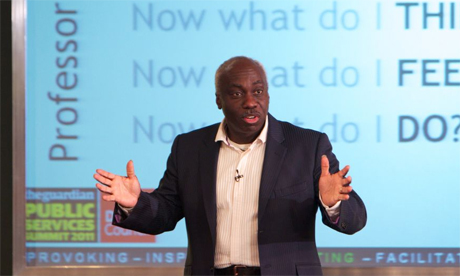
Eddie's keynote was described by the Guardian as '...stirring and inspiring...'
Monday, 20 December 2010
Exploring the BuyerSphere
If you’re involved in selling anything remotely complicated - anything that involves thoughtful consideration over an extended period by multiple stakeholders before a decision is made - you’ve probably noticed something.
The Old World “always be closing” approach to selling is increasingly irrelevant, and diminishingly effective. The harder we get sold to, the less we like it - unless we’ve acquired a taste for toying with dumb sales people. And our prospects feel the same.
It’s clear that the balance of information power has shifted from the seller to the buyer. Prospects no longer look to sales people for information, for the same reasons that they no longer attend trade shows, unless they work for local government.
They have found far better sources of insight. The internet - when combined with their formal and informal social and business networks - enables them to thoroughly research possible solutions and identify potential suppliers without the discomfort of having to speak to a sales person.
Buyers tell an old joke told about sales people. It goes “How do you know when a sales person is lying?” The inevitable answer? “When their lips are moving”. Funnily (or not) enough, sales people tell the same joke (with one obvious variation) about buyers.
So, in a world where buyers avoid the need to observe sales people’s lips moving until the last possible moment, what’s a New World vendor to do? I’d like to suggest a possible answer.

Today's prospects are influenced by a wide variety of sources, far beyond the traditional analyst and press community.
They look for recommendations from a community of trusted advisors, who can include formal and informal networks, business connections, existing vendors and many other sources - collectively referred to as their BuyerSphere.
Your prospects are building these connections, following these pathways of influence and forming opinions long before they decide to take action on an issue or reach out to a salesperson, with significant consequences for your sales process.
So how should a New World vendor respond? You can make a start by carefully exploring the BuyerSphere that surrounds your most valuable prospects and customers. Find out who they are influenced by. Learn who they trust. Find out where they naturally turn when their status quo is disturbed and they start searching for solutions.
And once you start to understand this web of influence, don’t hack through it like an Old World explorer in a pith helmet tramping their way through the undergrowth, and frightening everything within a five mile radius.
Don’t pitch, educate. Help your prospective customers learn from your experience. Encourage your existing customers and fans to help you get found in the places their peer group go looking for advice. Share your insights without expectation.
When (as it inevitably will) your generosity with your insights strikes a chord, make it easy for them to find out more. And coach your sales people to stop closing and start looking for ways to support your new prospect’s decision-making process.
Necessity is about to become a Mother Again*
Professor Eddie Obeng's guest blogger week at HM Government's Department of Business Innovation and Skills
Public Sector Innovation Blog 3
Public Sector Innovation Blog 3
Creating the Opportunity – How to systematically find chances to innovate
Professor Eddie Obeng's guest blogger week at HM Government's Department for Business Innovation and Skills
Public Sector Innovation Blog 2
Public Sector Innovation Blog 2
Innovation - it’s like playing the lottery…
Professor Eddie Obeng's guest blogger week
for HM Government Department of Business Innovation and Skills
Public Sector Innovation Blog 1
for HM Government Department of Business Innovation and Skills
Public Sector Innovation Blog 1
Sunday, 28 November 2010
Do PIGS choose Big Cuts or Happiness?
 The old joke was, "What's the difference between Iceland and Ireland?" The answer: "One letter and six months", proved inaccurate but only in timescale. Last week Pentacle (Eddie Obeng on the left and Toby Scott below) completed the delivery of the Leadership4Growth programme in association with Duke CE and Enterprise Ireland.
The programme, aimed at organisations associated with the built environment, was a practical programme to help Irish construction and related organisations get up off their knees and thrive again. In the wider context hunting down the PIGS began with a G not a P - Germany leading the bailout of Greece. In parallel in the UK starting with a bonfire (of Quangos) the solution to the BIG Cuts (which for some reason the journalists insist on constantly describing as 'Painful') is to get an even BIGGER Society. The question of “How much growth is enough? - If you can't grow as fast as the BRICs then how much growth is OK? – And anyway does growth make the citizens ‘Happy’?
To be honest all this focus on austerity, cuts and innovation is desperate, worthy but probably pointless - the chances of successful change execution and delivery, if anything like the normal averages, is very, very poor. Less than 25% of change activity delivers what was expected when it was expected at the cost expected. Even less than that number actually delivers the benefits originally envisaged. Or put another way, Monday, Tuesday, Wednesday and most of Thursday are spent but are not an investment because a real investment has a return in terms of benefits.
The goal is not to have a vision or strategy - the goal is to make it reality without wasting all the resources and benefits you hope that the vision or strategy will add.

In addition to releasing a new edition of the World After Midnight podcast Eddie has written and published
Necessity is about to become a Mother Again - To help you understand that not all innovation comes from the same sparqs and that you can select the best way of delivering innovation.
Big Cuts, Big Society, Excellent Execution and Happy Citizens - is a pragmatic but light hearted take on what would happen if the crises were being managed and delivered by Programme and Project managers rather than politicians and civil servants. It is a guide to what you should be doing yourself.
ESP - 100 Percent Perfect Projects - is a summary of the Breakthrough approach pioneered by Prof Obeng four years ago which enables delivery of huge benefits without waste. Basically it explains how you can deliver real change even though you have no money to invest by eliminating all the waste of change
The Blueprint for Transforming Strategy into Reality - How to organise for really BIG change
If I Knew Then What I Know Now… - To remind you that 21st century change in the New World is more closely aligned with sailing than driving and that the only way you can be really certain of success is to keep on track through reviews
Development. What a Monumental Waste of Time – Is a new take on developing organisational leaders for these difficult times. Moving away form the 20th century ‘Talent’ based thinking to a more appropriate solution.
So if PIGS could choose, And if the PIGS had read the articles would they choose BIG Cuts and Happiness? Webmail us here or joining the Pentacle LinkedIn Group. We think that they would.
Tuesday, 9 November 2010
Putting the human back into Business
Do you remember, not very long ago, when every customer counted and every touch point and experience was unique and personalised?
No. Neither do I. I think it is a myth brought on by watching too many heart-warming period dramas as a child. It may have been true at the corner shop, but was rarely if ever true of larger organisations.
What we recognise at Pentacle is that the environment in which organisations operate has become more complex; this may be due to globalisation, speed of communication or international competition. The more complex their environment becomes, the more those organisations are forced to adopt inflexible processes and one-size-fits all solutions that suit the organisation but rarely satisfy the consumer. They become "inhuman".
Nowadays, consumers are searching for authenticity and genuineness. These attributes do not come out of a tin marked "Humanity"; they are created by embedding a culture that places the consumer, or final user, at the heart of decision making. This means giving individual staff members autonomy and delegating power to the person who has the greatest expertise; usually the person closest to the customer.
At Pentacle, we are educating and enabling organisations to create and deliver authenticity to their customers by helping their employees to increase their capacity to manage complexity without becoming slaves to process or getting caught in the headlights of change.
We are helping companies to put the human back in their business.
Friday, 15 October 2010
Do you feel lucky, punk?
For many organisations the solution to the question, "How do we generate more innovation?" has a very simple answer. The answer is "Generate more ideas!" So a lot of organisational time and resource is dedicated to this in the hope that if they get enough ideas they will "Get Lucky".
But being lucky in generating ideas is not enough. Even a 'killer idea' is at risk of getting killed by the people across the organisation. Why? Because it was not-invented-here, because it means change, because they don't like the sound of it because they are human beings, because the senior management are cynical and won't support it, because the 'killer idea’ originated with a client need and there is no obvious part of the organisation which knows what to do with it, because executing an innovation project which is not completely locked-down doesn't work with the stage-gate or project management process, because we can't create the business case, because.... and the list continues. So they often react negatively against it and jump on it and block it doing their best to 'kill it'.
So unless the organisation is very, very lucky - so lucky in generating ideas and so lucky in having people who not only let the idea pass but actually work on it to realise it the goal of 'Generating more innovation' - it simply does not come to life.
 Imagine if instead of ‘hoping for luck’ we found out the places and things which caused the demise and death of all the 'unlucky' ideas. And imagine if we could then systematically remove the causes of the 'bad luck', we would be able to generate a significant amount of innovation without first having to be lucky. This is what Allianz, one of the UK's largest and best known insurance companies has done. Using the Pentacle R.A.B.B.I.T. Model, the Strategic Innovation Unit led by Jeremy Trott and sponsored by Philip Gennoy have transformed the delivery of innovation at all levels, from micro team-based opportunities to company changing strategic challenges.
Recently, David Lomas has joined the Pentacle team of Eddie Obeng, Christophe Gillet and Colin Burns who worked with Allianz at the inception of its i2s programme. David has been working with Jeremy and his team to develop Version 2.0 of the successful programme which has generated amazingly large numbers of new innovations and more importantly significant financial returns for Allianz.
So the choice is up to you. You can continue to be 'one of the herd', a typical organisation that approaches innovation-by-the numbers, hoping to get lucky. Or realise that you can systematically innovate for real returns with out having to be lucky at all.
 Well, do you feel lucky?
But being lucky in generating ideas is not enough. Even a 'killer idea' is at risk of getting killed by the people across the organisation. Why? Because it was not-invented-here, because it means change, because they don't like the sound of it because they are human beings, because the senior management are cynical and won't support it, because the 'killer idea’ originated with a client need and there is no obvious part of the organisation which knows what to do with it, because executing an innovation project which is not completely locked-down doesn't work with the stage-gate or project management process, because we can't create the business case, because.... and the list continues. So they often react negatively against it and jump on it and block it doing their best to 'kill it'.
So unless the organisation is very, very lucky - so lucky in generating ideas and so lucky in having people who not only let the idea pass but actually work on it to realise it the goal of 'Generating more innovation' - it simply does not come to life.
Imagine if instead of ‘hoping for luck’ we found out the places and things which caused the demise and death of all the 'unlucky' ideas. And imagine if we could then systematically remove the causes of the 'bad luck', we would be able to generate a significant amount of innovation without first having to be lucky. This is what Allianz, one of the UK's largest and best known insurance companies has done. Using the Pentacle R.A.B.B.I.T. Model, the Strategic Innovation Unit led by Jeremy Trott and sponsored by Philip Gennoy have transformed the delivery of innovation at all levels, from micro team-based opportunities to company changing strategic challenges.Recently, David Lomas has joined the Pentacle team of Eddie Obeng, Christophe Gillet and Colin Burns who worked with Allianz at the inception of its i2s programme. David has been working with Jeremy and his team to develop Version 2.0 of the successful programme which has generated amazingly large numbers of new innovations and more importantly significant financial returns for Allianz.
So the choice is up to you. You can continue to be 'one of the herd', a typical organisation that approaches innovation-by-the numbers, hoping to get lucky. Or realise that you can systematically innovate for real returns with out having to be lucky at all.
Well, do you feel lucky?
Monday, 27 September 2010
Home is where the Heart B.E.A.T. is!
Ghana is changing, and the executive team at Home Finance Company Bank (HFC Bank) in Accra, Ghana, have been quick to recognise this and are rapidly changing and expanding their business.
HFC Bank and their Human Resources Manager, Mr Emmanuel Adom are not content with, “Doing what they have always done before”. In their business world, where the pace of change is faster than their ability to learn, they are ready to put into practice New World Thinking.
.jpg) To help the Executive Team to more effectively lead the changes in HFC Bank, Pentacle Tutor Kwame Akuffo went 'back home' to Ghana - where he was born. He used a series of workshops to help the executives learn that they needed to develop several leadership styles in order to cope with all the multiple challenges of their business environment - and come out on top.
To help the Executive Team to more effectively lead the changes in HFC Bank, Pentacle Tutor Kwame Akuffo went 'back home' to Ghana - where he was born. He used a series of workshops to help the executives learn that they needed to develop several leadership styles in order to cope with all the multiple challenges of their business environment - and come out on top.
Kwame Akuffo facilitated the creation of personal development plans, devised to equip the managers for the surprises challenges and opportunities times that lie hidden in the future for HFC Bank.
.jpg) Participants learnt that in order to drive change, leaders must first look closer to 'home', actually to themselves and establish a B.E.A.T. They need to look at their own Behaviours and the paradigms that underpin those behaviours, Emotionally engage the hearts and minds of their teams, take Action with real courage and Think clearly about the challenges that lie ahead. The managers at HFC Bank really committed to adopting this approach and making it central to their leadership approach. So Kwame left them with the BEAT proving that for him, "Home really is where the Heart B.E.A.T. is!
Participants learnt that in order to drive change, leaders must first look closer to 'home', actually to themselves and establish a B.E.A.T. They need to look at their own Behaviours and the paradigms that underpin those behaviours, Emotionally engage the hearts and minds of their teams, take Action with real courage and Think clearly about the challenges that lie ahead. The managers at HFC Bank really committed to adopting this approach and making it central to their leadership approach. So Kwame left them with the BEAT proving that for him, "Home really is where the Heart B.E.A.T. is!
HFC Bank and their Human Resources Manager, Mr Emmanuel Adom are not content with, “Doing what they have always done before”. In their business world, where the pace of change is faster than their ability to learn, they are ready to put into practice New World Thinking.
.jpg) To help the Executive Team to more effectively lead the changes in HFC Bank, Pentacle Tutor Kwame Akuffo went 'back home' to Ghana - where he was born. He used a series of workshops to help the executives learn that they needed to develop several leadership styles in order to cope with all the multiple challenges of their business environment - and come out on top.
To help the Executive Team to more effectively lead the changes in HFC Bank, Pentacle Tutor Kwame Akuffo went 'back home' to Ghana - where he was born. He used a series of workshops to help the executives learn that they needed to develop several leadership styles in order to cope with all the multiple challenges of their business environment - and come out on top..jpg) Participants learnt that in order to drive change, leaders must first look closer to 'home', actually to themselves and establish a B.E.A.T. They need to look at their own Behaviours and the paradigms that underpin those behaviours, Emotionally engage the hearts and minds of their teams, take Action with real courage and Think clearly about the challenges that lie ahead. The managers at HFC Bank really committed to adopting this approach and making it central to their leadership approach. So Kwame left them with the BEAT proving that for him, "Home really is where the Heart B.E.A.T. is!
Participants learnt that in order to drive change, leaders must first look closer to 'home', actually to themselves and establish a B.E.A.T. They need to look at their own Behaviours and the paradigms that underpin those behaviours, Emotionally engage the hearts and minds of their teams, take Action with real courage and Think clearly about the challenges that lie ahead. The managers at HFC Bank really committed to adopting this approach and making it central to their leadership approach. So Kwame left them with the BEAT proving that for him, "Home really is where the Heart B.E.A.T. is!Sunday, 19 September 2010
The Precariat? NOT an early orange root vegetable!
Yes, it's a new buzz-word to us as well. It seems to be a concatenation of "precarious" and "proletariat". French sociologists a couple of decades ago used the word to describe a new class of 'unprotected', temporary or seasonal workers. It has since been adopted by the Japanese to describe workers who choose the flexibility of short-term contracts and temporary work rather than bow to the established job-for-life tradition of the 'salaryman'. Like them, we see these people as a critical part of the "virtual team" within an organisation that allow it to be flexible enough to respond to rapid change.
 Toby Scott, Director of Pentacle Ireland, will be provoking the audience, by proposing how the pace of change in the New World means that the Precariat will become the dominant employment group over the next decade or so, at a free symposium in Dublin arranged by GradCam, the Graduate School of Creative Arts and Media on Friday 24th September. Toby plans to then educate the audience on how to respond to the change and benefit from it.
Uproot yourself and join Toby if you can!
Toby Scott, Director of Pentacle Ireland, will be provoking the audience, by proposing how the pace of change in the New World means that the Precariat will become the dominant employment group over the next decade or so, at a free symposium in Dublin arranged by GradCam, the Graduate School of Creative Arts and Media on Friday 24th September. Toby plans to then educate the audience on how to respond to the change and benefit from it. Uproot yourself and join Toby if you can!
Saturday, 4 September 2010
Leadership in Crisis or Crisis in Leadership?

Friday, 3 September 2010
Let's Talk Again - Welcome to the World After Midnight Version 2.0
 Have you ever experienced that moment, when the drawing of the old witch transforms into a young lady? Or stared at a Magic Eye picture of coloured dots to suddenly see a butterfly emerge? Or that moment in the film The Matrix when Neo sees the data that makes the world in zeros and ones?
The next nine minutes will transform how you see the business and economic world around you. Things will never be quite the same again.

Welcome to the New World After Midnight....
NOTE: You can download a version from http://worldaftermidnight.com/
Sunday, 6 June 2010
Leading Others to Make Practical CHANGE in the Team and Organisation
Eddie Obeng and Robert Hewins have been working on an informal Pentacle survey of over a thousand managers and executives to find out what they feel their key learning needs are. The result was this wordle

Saturday, 22 May 2010
Eddie for President - But don't tell him...

There was a strange result in the Pentacle LinkedIn home page - It seems that people viewing Eddie Obeng's profile had him mixed up with someone else....
Subscribe to:
Comments (Atom)
.svg/2000px-My_Wife_and_My_Mother-In-Law_(Hill).svg.png)


 Posts
Posts